Gear
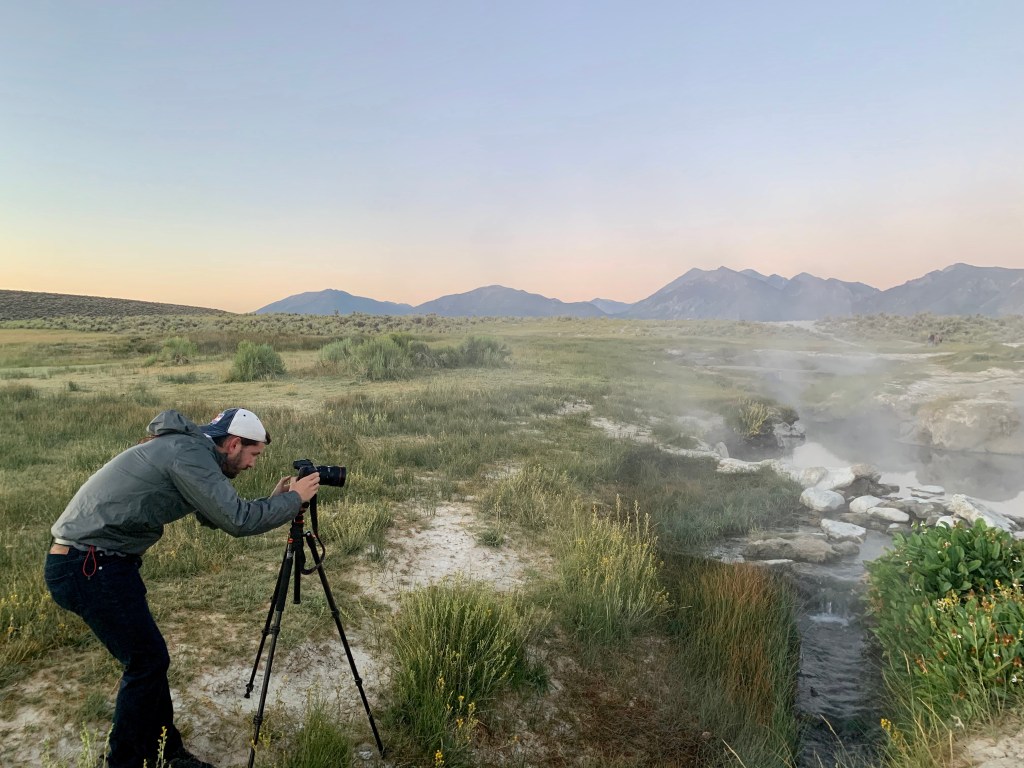
While my backpack is always the same, the stuff I carry along varies depending on where I’m heading and the goal of the adventure. Here’s what you’ll find me carrying around with me:
Canon:
- Canon R5 – This is my go-to camera for hybrid purposes. The video is fantastic, with full frame 4K as well as the ability to slow things down with 60 and 120 fps video. I updated to this body in 2020 for the better dynamic range, better weather sealing, full frame 4K video, and nearly perfect still image quality compared to nearly all other Canon bodies. So now, when I go out with just one camera on a hike and leave the heavy 5DSR and full kit at home, I can meet all my video and photography needs with just this body and a single lens.
- Canon 5DSR – While more of my specialty camera body dedicated to landscape photography, with it’s unfiltered, 50.6 megapixel sensor, it tends to be the camera body I’ll grab when a scene is static and likely to be a final portfolio image. It takes more time to create a careful, deliberate composition for a clean final image, but the exceptional detail is more than worth it! I absolutely love this camera despite the limitations and extra attention it demands.
- Canon 11-24mm f/4L – Holy Wide field of view! I cannot believe how much more of the scene this heavy chunk is able to squeeze into the frame. I never thought I would need something wider than my 16-35mm, but I must admit that this lens will help drive some creative perspectives and unique images that I otherwise would not have captured. With how heavy it is though (about on par with my 85mm 1.4L IS), I doubt this will be used on really long backpacking hikes. I’m sure I’ll take it along every now and then.
- Canon 16-35mm f/4L IS – An exceptionally sharp, lightweight wide angle lens. The IS is incredibly useful for blue hour photos and video work if hand holding, and the clarity can be even better than the workhorse 24-70mm 2.8L II. If keeping weight down is important on a long hike, I’ll pack just this and the 70-200mm f/4L II.
- Canon 24-70mm f/2.8L II – The standard workhorse lens that I usually grab 75% of the time. It’s tough, remarkably sharp, and so versatile with the wide angle to short telephoto view. If I could only take one lens out for the day, this is likely to be my first choice.
- Canon 35mm f/1.4L II – One of my favorite lenses for video work due to the exceptional clarity and low light ability with the huge aperture. It’s also a top option for portrait work, when weather sealing is needed for video work, and for when image sharpness & detail capture paired with the 5DSR are the highest priorities.
- Canon 85mm f/1.4L IS – This lens was a deliberate investment in portrait and video work. The ability to create separation for in field videos creates dramatic images that cannot be replicated by other lenses. The lens is superbly sharp and weather sealed, and it has a huge max aperture, making it an ideal video and portrait lens, as well as an option to bundle with the 35mm f/1.4L II and the 5DSR when chasing the pinnacle in image quality.
- Canon 70-200mm f/4L IS II – This is one of the best zooms I’ve ever owned. I briefly thought about selling it to fund the 100-400L, but they are materially different enough that there is a place in my collection for both. On any given hike, I’ll choose either this or the 100-400 depending on weight savings concerns or reach needs. When I’m looking for a lightweight kit, I’ll choose this zoom, the 16-35mm f/4L, and the R5 and call it a day with ~85% of potential photographic needs met.
- Canon 100-400mm f/4.5-5.6L IS II – Oh man, where to start. This lens is INSANE. It is so sharp, and so versatile, that if I could only pick one zoom it might be this. I could easily have a bag of the 35mm 1.4L II, 85mm 1.4L IS, and this zoom and never need another lens because all three are so stellar. The only time this one stays at home is when I need to save weight and choose to go with the 70-200 f/4L instead. Otherwise this lens is superior in every way.
- DJI Mini 2 – For years I’d never been a big fan of drones, but after DJI introduced a small, 4K-capable drone that weighed about as much as an apple and fit easily in my bag, I decided to take the plunge and add some aerial high definition abilities to my YouTube video work. I will also certainly introduce aerial photography as I continue to learn more about photographing from the sky!
Fuji Medium Format:
- Fuji GFX 50s II – For years it had been a dream to own a medium format camera, and after years of waiting for sky-high prices to adjust, I finally came across a used body that wasn’t priced in the stratosphere. In fact, it was priced so low I almost couldn’t believe it (cheaper than my R5 cost). Without hesitation, I finally welcomed a medium format camera to the family. Check out the video below where I compare the quality of the images from this body to my beloved 5DSR and trusty R5… I was certainly blown away by the initial results and I can’t wait to use this for many years to come. It is certainly specialized, yes, but when I need to achieve the ultimate in quality I have full faith that the GFX will deliver.
- Fuji GF 20-35mm – The best wide angle zoom lens I’ve ever used. It’s also relatively light and compact too, as you can see in my review of the lens where I compare to the EF 16-35mm f/4L and 11-24mm f/4L Canon wide angles. It balances perfectly on the GFX and really shines in any situation I’ve used it in.
- Fuji GF 45-100mm – This was the lens that first got me excited about the GFX system. Yes, it is HUGE. But, the images from this lens are simply otherworldly good. So crisp, great separation when needed, and a very useful 35-80mm equivalent range. I can pair with the 20-35mm and 100-200mm and have no overlap and almost all of my photographic needs covered.
- Fuji GF 35-70mm – My first GF lens. I was truly taken aback at how compact this little guy is, especially considering it has to cover nearly 2x the sensor size of a full frame camera. It weighs almost nothing and is a great walk around lens or ultralight hiking option. With the 50s II, this setup is lighter than any Canon combo I can put together except for using a tiny nifty-fifty. And way more useful, I should add. The sharpness and clarity are exceptional too.
- Fuji 100-200mm
- Fuji 1.4x Teleconverter
Fuji Travel & Hiking Kit:
- Fuji X-T5
- Fuji XF 10-24mm f/4 WR
- Fuji 16-50mm
- Fuji 18mm f/1.4
 B. Beatty Photography